 I often wonder about the censoring that occurs in the schools. Luckily I don’t often encounter it as Canada tends to be quite open-minded but I sure there’s still more than necessary in other countries around the world. Still, as a teacher, I tend to err on the side of caution as what I might think is perfectly fine may present a problem for some parents and families.
I have no idea what rules the schools had when I was young but I don’t remember not being allowed to read something. Then again, I probably wouldn’t know if something was kept away from me. My parents were very liberal when it came to books and as a preteen, I received the Judy Blume boxed set one Christmas.  I had read Are You There God It’s Me, Margaret, which all my friends were talking about, and I was dying to read the rest of her books. I had no idea that they would shortly become some of the most contested and maligned children’s books to date.
Judy Blume was a pioneer in her time (70’s); writing honest novels for kids and teens, tackling racism, handicaps, death and weight problems as well as puberty and first love. Once the 80’s hit and censorship skyrocketed she faced a constant battle against those who felt her books were inappropriate. She spoke out long and hard against censorship and for a child’s right to knowledge.
I knew none of this, but I did know I was reading about things that no one talked about. And of course I shared the books with my friends and we would have “clandestine meetings” to talk about them.
Are You There God It’s Me Margaret, the first of her novels that we got our hands on, openly discussed bras and periods and questions of friendship. All things we wondered about but never openly talked about. Girls today receive a thorough grounding in all areas of sexual education. Way back in the day though, once we hit grade 5, us girls were taken to watch “the film”, a brief outline of what we could expect when we “became women”. Of course they would encourage us to ask questions, but nobody ever did. The remainder of our sexual education came from Ms. Judy Blume.
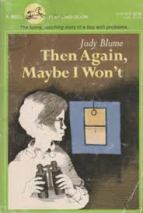 Then Again Maybe I Won’t gave us an insight into what happens to boys when they hit puberty, something no one ever talked to us girls about. I went on to read (and own) all of Blume’s books, but it’s Forever that I remember most vividly. Forever dealt with first love and losing virginity. The raciest topic yet. I remember passing Forever back and forth during band practice one day when I was in grade 7. One of the older girls had it and was sharing with us. We were hiding it behind our music and pointing out the “good parts” (Have you seen page 113!). It was about sex and we were pretty sure we weren’t supposed to be reading about sex, so the forbidden fruit attraction was definitely a draw.
  As an adult, I now realize what a frank and thoughtful insight that novel is into first love. My twelve year old self just recognized good characters I could root for. In very true-to-life Blume fashion, there was a realistic rather than a happy ending, which I appreciate now.
Fiction reading is an invaluable source of information for children and teens, and well written material should always be celebrated. I applaud Judy Blume for her courage in writing the truth and thank her for playing such a pivotal role in my childhood education.
 A fascinating question really. With the advancements in genetics it’s only a matter of time I imagine. Clone stories seem to be everywhere over the past couple of years (
 As I was immersed in the chaos of the first week of school (and wondering how I could ever have forgotten the ear-shattering decibel level of 200+ girls in one room), I started thinking about how the books we read as children shape who we become.
 I don’t remember the first Enid Blyton book I read, but I remember systematically working my way through her entire repertoire (and our small town library had them all). For those of you not familiar with her work, she wrote adventure stories and child detective/club stories in the 40’s and 50’s. As much as I loved her Adventure series, I loved her boarding school stories even more. I loved school and could think of nothing more exciting than living at school! Classes, and strict teachers, and living with friends and studying at night! I wanted to wear a sharp uniform, abide by the rules and go to an all-girl school too! The fact that Ms. Blyton was describing life during her own time period never occurred to my 8 year old self. To me, that was what school was like in England and I wanted to go there, not to my boring old school in Canada.
 My Childhood Bookshelf